

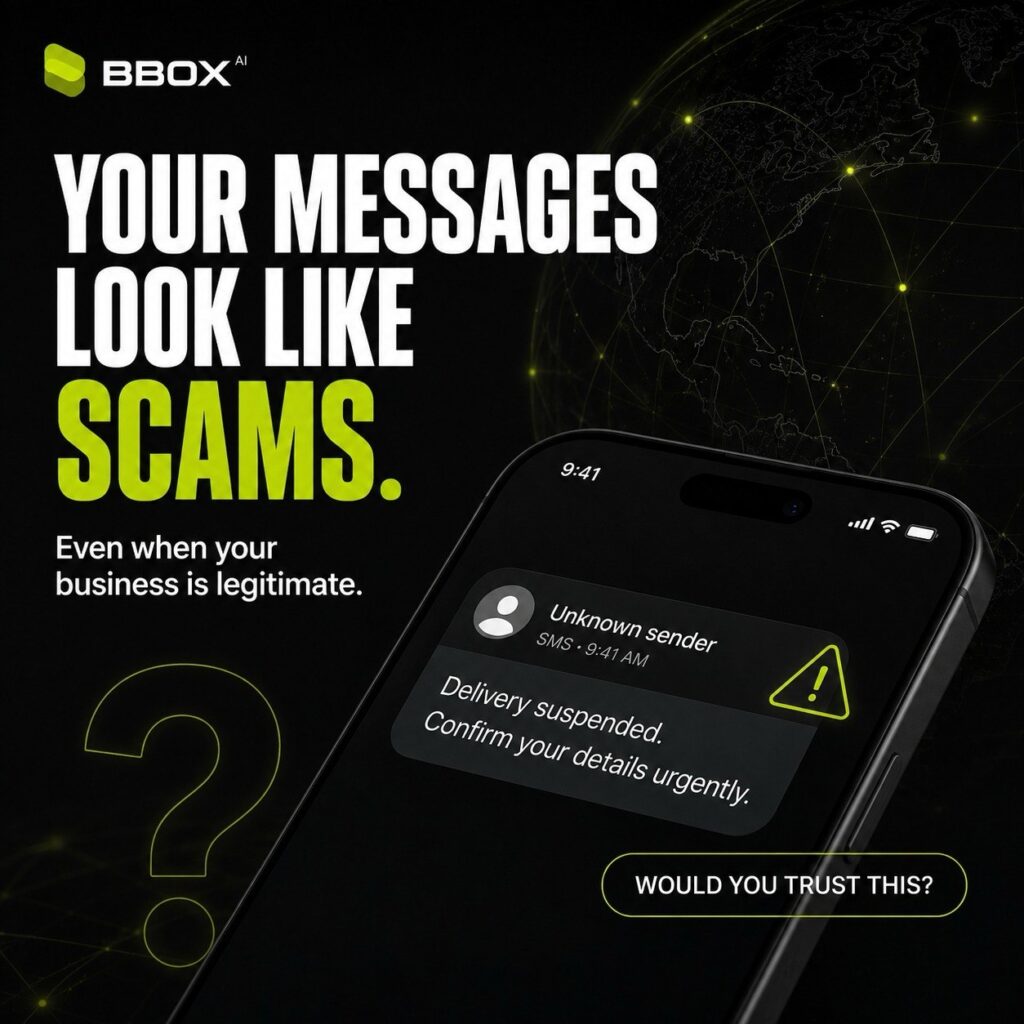
The order is real. The courier really did try to deliver it. The customer genuinely needs to update their address.
So you send this:
Delivery suspended. Confirm your details urgently using the link below to receive your parcel.
Now read it as someone who knows nothing about your delivery system or your good intentions.
Which parcel? Who is this? What details do they want? And why the rush?
You were trying to help someone receive an order. Instead, you’ve given them another message to be suspicious of.
That’s a problem for business messaging: a message can reach the right phone and still fail to do its job.
Your customer has good reasons to be suspicious
In 2024, consumers reported $470 million in losses from scams that began with text messages to the US Federal Trade Commission. That figure covers reported losses, not the full global cost. Fake package delivery notifications were the most commonly reported type of text scam. FTC findings
The setup is familiar: something has gone wrong with a delivery, you need to fix it, and there’s a link.
The FTC advises people to check orders through a website they know rather than follow links in unexpected delivery messages. FTC consumer guidance
That leaves legitimate businesses in an awkward position. Your campaign needs a click. Your customer has been taught that clicking could be a mistake.
Before sending an SMS campaign, ask: what gives the recipient a reason to recognise this message and understand why it arrived?
You have the context. They have a few lines of text.
Inside your company, the situation is obvious. There’s an order number, a payment record and a delivery address.
Somehow, the customer gets:
Action required.
Imagine someone who has ordered trainers, a birthday present and dog food in the same week. “Your order has been delayed” now gives them three possible problems to investigate.
A little context saves them the guesswork.
The examples below are illustrative rewrites of everyday situations, not actual messages from named businesses.
Vague:
We couldn’t deliver your order. Update your details using the link below.
Clearer:
North Store: we couldn’t deliver order #4821 today. Choose another delivery date in the app under My Orders → Delivery.
The second version identifies the shop, names the order and explains what to do. The customer can act by opening the app themselves.
You don’t need to squeeze a full address or a detailed purchase history into a transactional SMS. Include enough information to make the situation recognisable without exposing unnecessary personal details.
“Urgent” doesn’t explain the problem
Sometimes there really is a deadline. A reservation may expire. A payment may need attention.
Give the customer the deadline and explain what happens next.
Vague:
FINAL WARNING! Pay now or lose your booking.
Clearer:
Harbour Hotel: the deposit for booking #7312 is due by 6 pm on 12 September. Your booking will be cancelled if payment isn’t received. Check the details in your account.
The second message gives someone a specific reason to act. They can check it against a booking they already know about.
The same principle applies to SMS marketing. If an offer ends on Sunday, give the date. If every subscriber qualifies for a discount, don’t announce it as a prize the recipient has personally won.
A customer can decline an honest offer and still trust your next message. Invented urgency makes that harder.
Your link is part of the message
The company name looks familiar. The wording makes sense. Then comes a link with an unfamiliar domain and a string of random characters.
To the marketing team, it may be a standard tracking link. To the customer, it’s another unanswered question.
Check the whole journey:
Is the domain recognisable?
Does the page use the same brand name as the message?
Does the link lead directly to the promised action?
Can the customer find the same information independently through your website or app?
That last point matters particularly when a message involves payments, account details or security.
For example:
Your subscription payment didn’t go through. Open the app and check your payment method under Subscription.
The message remains useful to someone who never clicks links in texts.
A familiar domain or an accurate order number should never be presented as proof that a message is genuine. Recognisable details reduce confusion; an independent way to check gives the customer something more useful than reassurance.
Check the sender on an actual phone
Your campaign dashboard might display a perfectly sensible internal name. The customer might see a number they’ve never encountered before.
SMS Sender ID—the name or number shown as the sender—needs attention before launch. Support for alphanumeric sender names and registration requirements varies by destination country. A setup that works in one market cannot simply be assumed to work everywhere. Sender ID documentation
Other messaging formats offer additional ways to identify a business. RCS Business Messaging, for example, includes a brand verification process. Google’s brand verification documentation
But a business profile still leaves the copy with a job to do. It doesn’t explain why someone has suddenly received a “guaranteed reward” or what an unexpected payment request relates to.
Before a campaign goes live, review a test message on a real device. Check the sender, the preview, the link and the destination page. That’s the version your customer has to judge.
Don’t introduce yourself as a different company in every channel
In email, you use the shop’s name. In SMS, you appear as an unfamiliar number. In WhatsApp, you use the legal entity behind the business – a name the customer has never heard.
Inside the company, those identities are connected. On the customer’s phone, they may look like three unrelated senders.
Keep names, branding and wording consistent across your customer communications. If a delivery or payment partner will contact the customer, explain the connection beforehand.
Someone who bought a lamp from a shop they know shouldn’t have to investigate an unfamiliar company just to arrange delivery.
A click isn’t the only sign that a message worked
Suppose a customer reads your payment notification, opens the app independently and updates their card.
Your link gets no click. The message has done its job.
Measure SMS campaign performance against the action you actually need: a completed payment, a confirmed appointment or a rescheduled delivery. Where the data is available, also track opt-outs, complaints and support queries asking, “Did you send this?”
To test clearer wording, compare two versions with similar recipient groups. Keep one as your current message. Give the other more recognisable context and a straightforward way to check the request. Decide in advance which completed action matters and how long you’ll measure it.
There’s no credible universal percentage for how much clearer wording will improve results. You need to find out what changes for your audience.
Start with the last message your business sent. Open it on your phone and imagine you’re reading it between a work call and a supermarket queue.
Can you tell who sent it, why it matters and how to check it?
If you have to stop and work that out, so does your customer.