

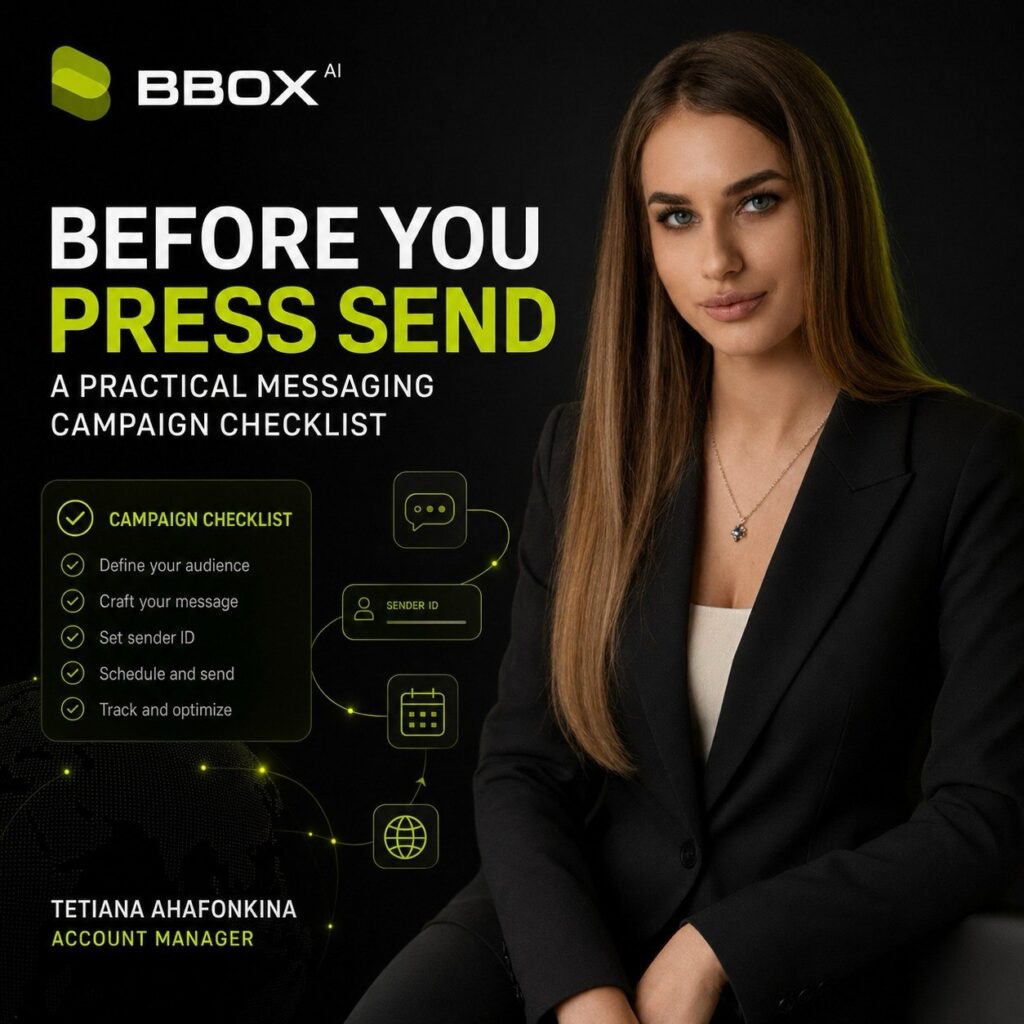
Launching a business messaging campaign may seem simple: prepare the text, upload the recipients and press “Send.”
In reality, a successful launch begins much earlier.
Whether you are planning an SMS marketing campaign, sending OTP codes or introducing a new messaging channel, a few missing details can delay the launch or create unnecessary questions along the way.
From an account manager’s perspective, the best campaigns are not always the most complicated ones. They are usually the campaigns where the client and the messaging provider have a clear understanding of the objective from the beginning.
“Good preparation does not make a campaign slower. It is what allows us to launch it faster.”
Here is a practical messaging campaign checklist that can help your team prepare for a smooth and predictable launch.
1. Start with the purpose of the message
Before discussing routes, prices or integrations, define what the message is supposed to do.
Is it:
an OTP or verification code;
a transactional notification;
a payment or account alert;
a promotional campaign;
a customer reactivation message;
a service update;
or a reminder?
This distinction is important because different message types may be treated differently by mobile operators and messaging platforms. A route suitable for OTP traffic may not be suitable for promotional messages. Some countries and channels also have additional restrictions for particular industries or types of content.
You do not need to know all the technical or regulatory details yourself. That is something your messaging provider should help you check. However, the provider needs to understand the purpose of the traffic before recommending a solution.
Simply saying, “We need SMS” is usually not enough.
A much better starting point is:
“We need to send login verification codes to customers in Germany, France and the United Kingdom. The expected monthly volume is approximately 100,000 messages.”
That one sentence already answers several important questions.
2. Confirm the destination countries
International business messaging is not the same in every market.
Sender ID requirements, content restrictions, registration procedures and available messaging channels can vary by country. In some destinations, a branded Sender ID can be used immediately. In others, it must be registered in advance.
For this reason, always prepare a clear list of target countries before requesting pricing or planning a campaign.
If the campaign covers several markets, it is also helpful to indicate:
the expected volume for each country;
the language of the messages;
whether all countries will launch at the same time;
which markets are the highest priority.
This allows your SMS provider to check the correct setup for every destination and identify any registrations that may be required.
“Global coverage is important, but every country is still its own market. The earlier we know where you want to send, the better we can prepare the launch.”
3. Share the actual message text
One of the most useful things a client can provide is also one of the simplest: the message itself.
Whenever possible, share the exact SMS or messaging template before the campaign starts. If the final wording is not ready, provide a realistic example.
The message text helps the provider check:
whether the content matches the declared traffic type;
whether the Sender ID and brand mentioned in the message are consistent;
whether a link or domain needs to be reviewed;
whether the message may be divided into multiple SMS segments;
whether any words or symbols could create problems in a particular market;
whether an opt-out instruction may be required.
Avoid using placeholders such as “some promotional text” or “standard OTP.” Two messages that appear similar from a business perspective may be treated differently depending on their wording.
For example:
OTP message:
“Your BBOX verification code is 482916. It expires in 10 minutes.”
Promotional message:
“Your weekend offer is available. Activate it before midnight: [link]”
These messages have different purposes and may require different routes, rules and preparation.
If the wording changes significantly before launch, inform your account manager. A previously approved setup may need to be checked again.
4. Decide which Sender ID the customer should see
The Sender ID is the name or number displayed as the sender of an SMS.
For most businesses, using a recognisable brand name creates more trust than sending from an unfamiliar number. However, the availability of alphanumeric Sender IDs depends on the destination.
Before the launch, confirm:
the exact Sender ID you want to use;
the company or brand it represents;
the website associated with the brand;
whether you need customers to reply to the message.
This last point is easily overlooked. An alphanumeric Sender ID may look professional, but it usually does not allow the recipient to respond. If two-way communication is required, the campaign may need a different setup.
Sender ID registration can also take time, especially when documents or confirmation from the brand owner are required. It is better to begin this process before the planned launch date rather than one day before the campaign.
5. Check every link and landing page
If your message contains a link, send the complete URL to your provider during the preparation stage.
The domain should be active, secure and clearly connected to the brand. A customer receiving the message should understand where the link will take them.
Before launching the campaign, open the link on a mobile device and check:
whether the page loads quickly;
whether it is easy to use on a small screen;
whether the offer matches the message;
whether the correct language is displayed;
whether the registration or payment process works;
whether tracking parameters have been added correctly.
A well-written message cannot compensate for a landing page that is slow, confusing or unavailable in the customer’s country.
Shortened links also need attention. Public URL shorteners can look suspicious to recipients and may be restricted in some markets. Using a branded domain is normally a better choice for both trust and consistency.
6. Provide realistic volume expectations
The expected volume helps the messaging provider recommend the appropriate commercial and technical setup.
Try to provide realistic estimates rather than only the maximum possible number.
Useful information includes:
estimated monthly volume;
expected daily volume;
approximate number of messages per campaign;
whether traffic will be continuous or sent in large batches;
expected growth over the next few months.
For OTP and transactional traffic, it is also important to explain whether the volume is stable or whether there can be sudden peaks during registrations, promotions or major events.
You do not need to predict every message precisely. An approximate but realistic forecast is enough to start a useful conversation.
7. Agree on timing and time zones
“When do you want to launch?” sounds like a simple question, but it may have several answers.
There is the date when the technical setup should be ready, the date when testing begins and the date when the first live campaign is sent.
Make these milestones clear.
For international campaigns, consider the recipient’s local time rather than only the time zone of your own team. A message sent at the right moment can feel relevant. The same message sent in the middle of the night can feel intrusive.
It is also useful to tell your account manager about any fixed deadlines. If the campaign is connected to a product launch, sporting event, seasonal promotion or regulatory notice, the provider can work backwards from that date and explain what must be prepared first.
“An urgent campaign is much easier to support when we know that it will be urgent in advance.”
8. Prepare suitable test numbers
Testing should reflect the real campaign as closely as possible.
Provide test numbers for the destination countries and, where possible, for different mobile operators. Make sure the people using those numbers know what they need to check.
A useful test is not only about receiving a message. It can also confirm:
how the Sender ID appears;
whether the full text is displayed correctly;
whether the link opens;
whether the language and symbols are correct;
how quickly an OTP arrives;
whether the customer journey works from beginning to end.
For example, if you are testing an OTP flow, do not stop after receiving the code. Enter it and confirm that the login or registration process is completed successfully.
Small details noticed during testing are much easier to correct than the same details noticed after a campaign has reached thousands of recipients.
9. Confirm consent and opt-out requirements
Before sending promotional messages, make sure that the recipients have given the necessary consent and that your company can demonstrate how this consent was collected.
Your team should also understand how customers can stop receiving future communications.
The exact requirements depend on the country, channel and type of campaign. If you are uncertain, discuss the use case with your compliance or legal team and inform your messaging provider before launch.
The provider can explain the technical and operational requirements of the channel, but responsibility for the customer database and lawful consent remains an essential part of the campaign.
Good consent management is not only a legal formality. It also protects the quality of your audience and reduces complaints from people who did not expect to hear from your brand.
10. Decide how you will measure the campaign
Before sending anything, agree internally on what success means.
For an OTP service, the key result may be successful verification or completed registration. For a promotional campaign, it could be clicks, deposits, purchases or reactivated customers.
The messaging platform can provide information about message processing and delivery, but your own systems usually provide the business result.
Useful metrics may include:
messages submitted;
messages delivered;
link clicks;
completed registrations;
successful OTP verifications;
conversions;
opt-outs;
cost per completed action.
Defining these metrics before the campaign makes the final analysis much more useful. Otherwise, teams sometimes collect a large amount of data without knowing which numbers actually matter.
11. Have a backup plan
Even a well-prepared campaign may need an alternative.
A particular route, market or messaging channel can behave differently from what was expected. That does not mean every campaign needs a complicated multichannel system, but it is worth discussing the available options before they are urgently needed.
Depending on the use case, the backup plan could include:
an alternative SMS route;
another approved Sender ID;
a second messaging provider;
SMS fallback for an OTT channel;
an additional channel such as WhatsApp, Viber or Telegram;
a process for escalating urgent questions.
For critical OTP and transactional communication, having a backup option can be especially valuable.
A simple brief makes a real difference
A messaging campaign does not need a 20-page project document.
In many cases, a short and clear brief is enough:
Purpose: OTP, transactional or promotional
Countries: Target destinations
Volume: Monthly estimate and expected peaks
Sender ID: Brand name or number
Content: Exact message examples
Links: Domains included in the message
Timing: Testing and launch dates
Test numbers: Preferably across relevant operators
Consent: How recipients joined the database
Success metric: What the business wants to achieve
The more clearly these points are communicated, the easier it is for the account manager, technical team and client to work together.
Final thoughts
The role of an account manager is not only to answer questions after a campaign has started. It is also to help the client ask the right questions before the launch.
A clear objective, realistic timeline and complete campaign brief can prevent many avoidable delays. They also give the messaging provider enough information to recommend the right channel and setup from the beginning.
“The best launch is not the one with no questions. It is the one where the important questions are answered before the first message is sent.”
At BBOX AI, we help businesses prepare and launch international messaging campaigns across SMS, WhatsApp Business, Viber and Telegram. If you are planning a new campaign or entering a new market, our team can review your requirements and help you prepare the right setup.